Introduction
High‑quality slewing bearings rely on standardized machining procedures starting from raw forging blanks. Rough turning is the first critical step to remove excess material, correct forging deformation and lay a stable foundation for subsequent finishing, heat treatment, gear processing and assembly. At Longwei, we strictly control every turning procedure to guarantee dimensional stability for all our slewing bearing products used in construction cranes, port machinery, offshore platforms and mining equipment.
What Is Rough Turning of Slewing Bearing Blanks
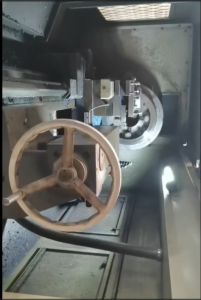
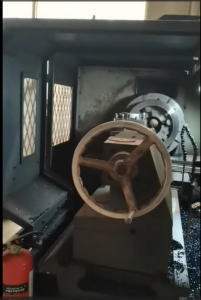
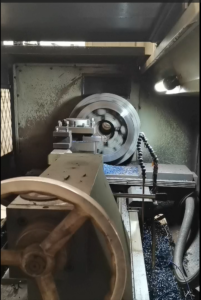
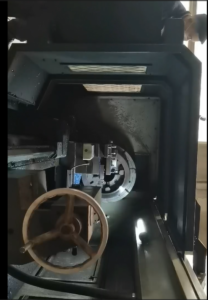
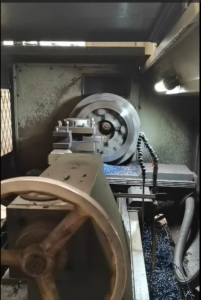
Rough turning is the primary metal‑cutting process after forging. On the horizontal CNC lathe, large‑size annular slewing bearing blanks are clamped securely. The machine removes large margins of extra material quickly, cutting the outer circle, inner hole and end faces to get close to the preliminary design dimension.
A large amount of metal chips will be generated during this heavy‑duty cutting stage. This step does not pursue ultra‑high surface finish; its core goal is:
1. Eliminate irregular surfaces and oxide layers from hot forging
2. Reduce workpiece vibration in later fine‑turning processes
3. Keep uniform machining allowance for the next production steps
Why Horizontal Lathes Are Preferred for Slewing Bearing Blank Machining
Slewing bearings are large‑diameter annular parts. Horizontal lathes bring obvious advantages for rough‑turning work:
– Strong clamping rigidity, suitable for heavy cutting of large ring forgings
– Stable feed system to avoid offset during deep cutting
– Convenient chip removal, good heat dissipation in continuous mass production
– High efficiency for batch processing of standard slewing bearing blanks
After rough turning, each blank will go through inspection for dimension, roundness and surface defects before moving to fine turning. Unqualified semi‑finished products will be screened out at this stage to reduce waste in later processes.
Our Slewing Bearing Product Range
We manufacture all types of slewing bearings: single‑row ball slewing bearings, double‑row ball slewing bearings, cross roller slewing bearings and three‑row roller slewing bearings. Our products are widely supplied for tower cranes, excavators, port cranes, offshore working platforms, wind power equipment and automation machinery globally.
If you are searching for reliable China‑made slewing bearings, welcome to check our product catalogue or contact us directly via WhatsApp: +86‑18251830668 for your project quotation.
Conclusion
Every high‑performance slewing bearing starts from precise rough turning of the forging blank. Stable equipment, standardized operating procedures and strict in‑process inspection together ensure consistent product quality. If you want to know more about our full slewing‑bearing manufacturing workflow, stay tuned for our next blog posts about fine machining, heat treatment and assembly.