
Many customers often confuse two similar-looking machining processes when viewing production footage of slewing bearings: inner bore chamfering and slewing ring mounting hole drilling.
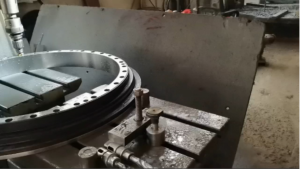
In our on-site video, the vertical machining center drills through holes vertically on the flange face of the slewing ring. This process creates mounting holes, used to fasten the slewing bearing to host equipment such as excavators, cranes, piling rigs and offshore machinery. A minor edge chamfer can be added after drilling to remove burrs, protect bolts during assembly and simplify installation.
Inner bore chamfering, which was mentioned in our on-site discussion, is a separate machining step.
It is normally completed on a CNC vertical lathe. Cutting tools travel along the circular edge of the inner ring to machine the chamfer of the inner bore. This operation deburrs the inner edge, avoids stress concentration, and prevents scratches on matching components during assembly.
Key Differences
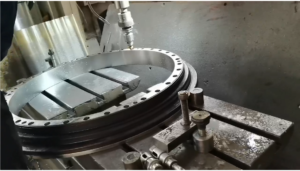
1. Slewing bearing mounting hole machining (shown in the footage)
Equipment: Vertical machining center
Tool: Twist drill + chamfer tool
Purpose: Produce mounting holes for connection bolts
2. Inner bore chamfering
Equipment: CNC vertical lathe
Tool: Turning tool
Purpose: Deburr the inner circular edge, optimize assembly and mechanical performance
Every processing step directly determines the precision, service life and reliability of the finished slewing bearing. Strict quality control is implemented for all procedures from rough machining, heat treatment, raceway grinding to final assembly and clearance testing.
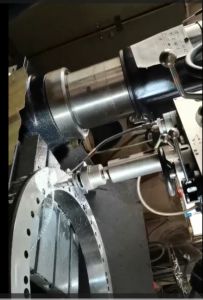
If you need custom slewing bearings for construction, mining or offshore equipment, feel free to contact us for technical drawings and quotations.